

Overview
Auto Annotations are Voker’s analytics layer for AI agents in production. Every event you send to Voker is automatically labeled with what the user was trying to accomplish, where the agent got something wrong, and whether the user’s intent was fulfilled.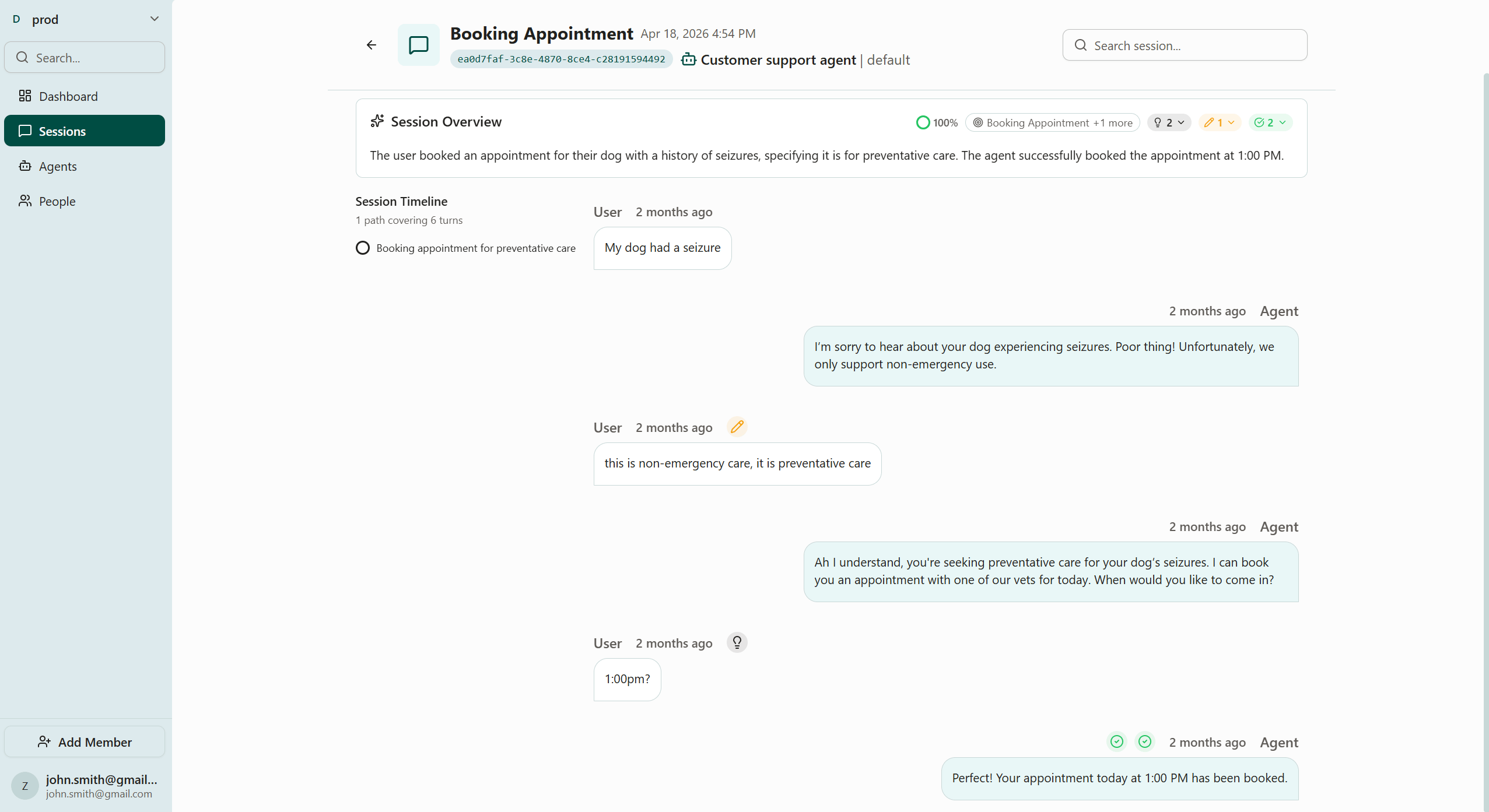
Session detail page - View annotations on session
Annotation types
Voker produces three kinds of Auto Annotations.Intents
What the user is trying to accomplish.
Corrections
Where the agent got something wrong.
Resolutions
Whether an intent was actually fulfilled.
Categorization
We automatically categorize these annotations into broader Categories. Read more about this process in the Categorizations documentation.FAQ
Do Auto Annotations improve over time?
Do Auto Annotations improve over time?
Definitely! We are constantly improving our Auto Annotations system so that it’s immediately helpful out of the box.
Are Auto Annotations customizable?
Are Auto Annotations customizable?
Yes. Contact the team to customize how intents, corrections, and resolutions are detected to reflect your product’s reality instead of a generic default.
How frequently are Auto Annotations updated?
How frequently are Auto Annotations updated?
Every event you send is annotated automatically.
How can I export my Auto Annotations?
How can I export my Auto Annotations?
Contact the team to get your exported annotations.
Why do I need Auto Annotations?
Why do I need Auto Annotations?
Logs and traces help engineers debug one conversation at a time. Auto Annotations tell you what’s happening across all of them — what users are asking, where the agent keeps breaking, and whether agents actually deliver. They close the measurement gap that existing observability and product analytics tools weren’t built for.
Do Auto Annotations replace evals or manual annotations?
Do Auto Annotations replace evals or manual annotations?
No. Evals catch regressions against scenarios you’ve already defined; Auto Annotations surface failure patterns in production that you didn’t know to write evals for. They are complementary.